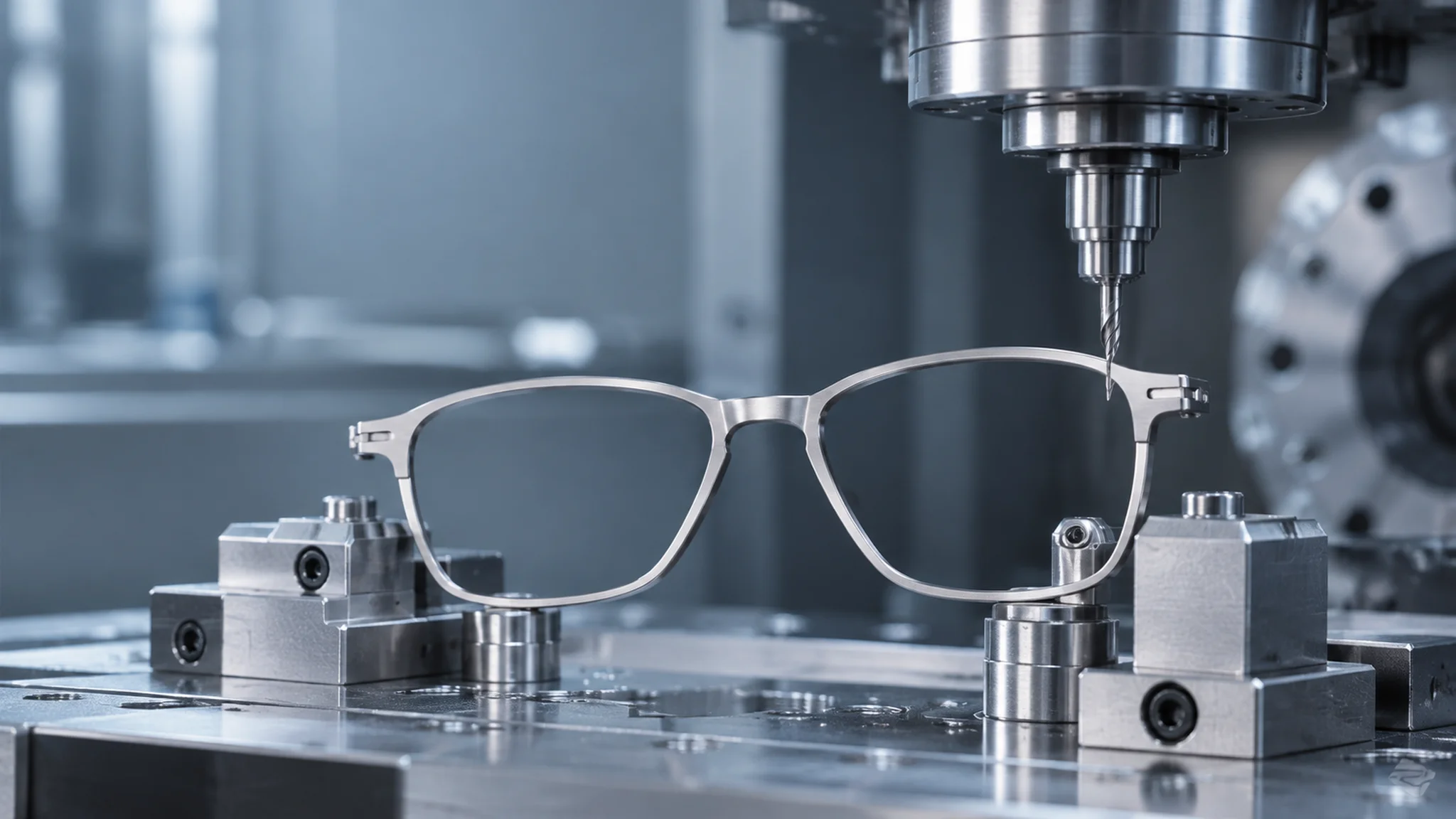
Titanium eyewear is valued for its light feel, corrosion resistance and premium appearance. For wholesale brands, however, the material choice is only the beginning. Consistent results depend on how each frame component is machined, joined and inspected throughout production.
This guide explains the manufacturing checkpoints that help turn a titanium eyewear concept into a repeatable OEM product: precision CNC machining, controlled laser welding and practical tolerance management.
Titanium frames combine slender profiles with functional details around the bridge, end pieces, temples and hinge areas. Small variations can affect alignment, folding action, lens positioning and the final fit. A controlled machining process helps keep these relationships consistent from prototype to production.
CNC machining is used to shape and finish precise titanium parts such as bridges, end pieces, temple details and other small structural components. The process translates approved CAD geometry into repeatable machining steps, while tooling, fixturing and process checks help control variation.
| Checkpoint | What to review |
|---|---|
| CAD and drawings | Are critical interfaces, hole positions and reference surfaces clearly defined? |
| Tooling and fixtures | Are delicate parts supported securely without marking or distortion? |
| First-article inspection | Are prototype dimensions and assembly relationships checked before volume production? |
| In-process control | Are repeat checks built into the production plan for critical features? |
Laser welding can support precise joining of titanium eyewear components where a clean and localized heat source is important. Joint preparation, alignment, energy control and post-weld inspection all influence the consistency of the finished frame.
For an OEM project, the goal is not simply to create a visible weld. The joint should support the approved design, preserve the intended geometry and remain compatible with later finishing and assembly steps.
Tolerance control works best as a connected system rather than a final inspection step. The product team should identify critical dimensions early, establish inspection references and compare samples against the approved design before scaling up.
Before placing a wholesale order, ask how the factory manages the handoff from design to machining, welding, finishing and assembly. Useful questions include:
Reliable titanium eyewear manufacturing is built on repeatable details: accurate CNC machining, controlled laser welding and a tolerance plan that connects prototypes with production. For brands developing a premium collection, reviewing these checkpoints early can make supplier communication clearer and help protect consistency across the final range.
Looking for a partner for custom titanium eyewear? Ajaoptical supports OEM and ODM development from design communication through prototype and production coordination. Contact our team to discuss your next frame project.